
Choosing the right professional audio equipment is one of the most important decisions for any organisation involved in live events, entertainment, education or commercial installations. A well-designed sound system does much more than increase volume. It ensures every word is understood, every musical note is reproduced accurately and every audience member enjoys the same listening experience, whether they are sitting in the front row or at the back of the venue.
Today’s professional audio industry offers an enormous range of products, from compact conference systems to large-scale line array solutions capable of covering stadiums and festivals. While this variety gives buyers more choice than ever before, it also makes selecting the right equipment considerably more challenging. Choosing equipment based only on brand recognition, power ratings or price can easily result in a system that fails to meet the needs of the venue or event.
For many businesses, purchasing professional audio equipment represents a significant investment. Event production companies need equipment that performs reliably every weekend. Hotels require systems that are easy for staff to operate. Churches often need exceptional speech clarity, while rental companies look for durable products capable of withstanding constant transportation and setup. Every application has its own technical requirements, and understanding those differences is the key to making a smart purchasing decision.
Buying used professional audio equipment has also become increasingly popular throughout Europe. Many of the industry’s most respected manufacturers design their equipment to withstand years of demanding use, making professionally maintained pre-owned equipment an attractive option for organisations seeking premium performance while managing budgets responsibly.
This Professional Audio Equipment Buying Guide explains the core components of a professional sound system, the applications they are best suited for, the features that matter most and the common mistakes buyers should avoid. Whether you are purchasing your first professional PA system or expanding an existing installation, the goal is to help you choose equipment that delivers dependable performance today and remains suitable for your future requirements.
What is Professional Audio Equipment?
Professional audio equipment refers to commercial-grade sound systems and components designed to deliver reliable, high-quality audio in demanding environments. Unlike consumer audio products intended primarily for home entertainment, professional equipment is built for continuous operation, greater flexibility and consistent performance across a wide range of applications.
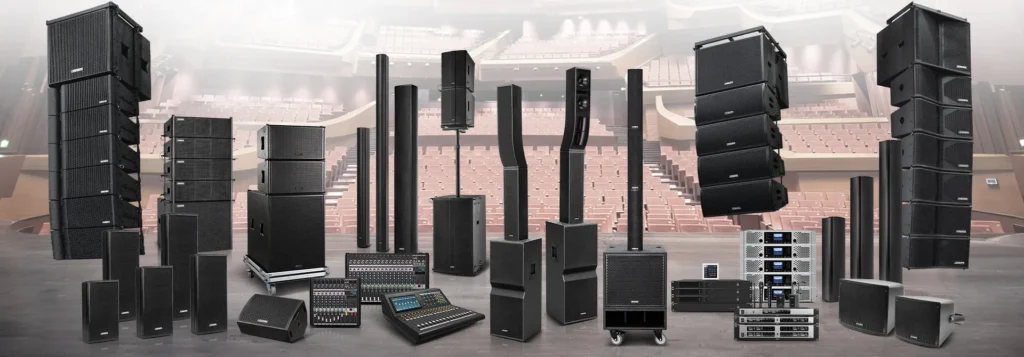
A professional audio system consists of multiple components working together. These typically include loudspeakers, subwoofers, amplifiers, mixing consoles, microphones, signal processors and the cables required to connect them. Each component performs a specific function, and the quality of the overall system depends on how well these products work together.
When someone speaks into a microphone, the microphone converts sound into an electrical signal. The mixing console receives that signal, allowing an engineer to adjust volume, equalisation and routing. The processed signal then passes through amplifiers—or built-in amplifiers in active speakers—before reaching the loudspeakers, which convert the electrical signal back into sound for the audience.
Modern professional audio systems often include digital networking, remote monitoring, wireless control and integrated digital signal processing (DSP). These technologies improve efficiency, simplify installation and allow sound engineers to manage complex systems with greater precision than ever before.
Professional audio equipment is used wherever clear, reliable sound is essential. Examples include:
- Live concerts
- Music festivals
- Corporate conferences
- Hotels
- Universities
- Government buildings
- Houses of worship
- Sports arenas
- Broadcast studios
- Theatres
- Exhibition centres
- Permanent commercial installations
One of the defining characteristics of professional equipment is reliability. Many systems operate for several hours every day under demanding conditions, often being transported between venues, exposed to varying temperatures or installed permanently in challenging environments. Manufacturers therefore design professional products using durable materials, high-quality components and rigorous testing procedures to ensure dependable performance.
Who Should Buy Professional Audio Equipment?
Professional audio equipment serves a wide range of industries and organisations. While every application differs, the underlying objective remains the same: delivering clear, dependable sound that meets the expectations of audiences, performers and presenters.
Event Production Companies
Event production companies require flexible systems capable of adapting to different venues and event sizes. Equipment must be portable, reliable and quick to deploy while maintaining excellent sound quality across corporate events, concerts and festivals.
AV Rental Companies
Rental businesses often invest in equipment that balances durability, ease of transportation and broad compatibility. Products that are simple to configure and withstand frequent handling typically offer the greatest long-term value.
Churches and Houses of Worship
Places of worship often prioritise speech intelligibility, wireless microphone systems and discreet loudspeaker installations that complement the architecture of the building while ensuring every member of the congregation hears clearly.
Conference Centres
Conference facilities require systems that reproduce speech naturally without feedback or distortion. Ease of operation is particularly important, as staff members may have varying levels of technical knowledge.
Hotels and Hospitality Venues
Hotels frequently use professional audio systems across multiple spaces, including meeting rooms, banquet halls, restaurants and outdoor event areas. Flexible zoning and simple control systems help staff manage different events simultaneously.
Theatres and Performing Arts Venues
Theatres rely on precise sound reinforcement, multiple wireless microphones and advanced digital mixing consoles capable of storing different settings for each production.
Educational Institutions
Schools, colleges and universities use professional audio equipment for lectures, graduation ceremonies, sporting events and performance spaces. Reliability and ease of maintenance are often major considerations.
Broadcast Studios
Television and radio production demand equipment capable of reproducing sound accurately while integrating seamlessly with recording and transmission systems.
DJs and Live Sound Engineers
Professional DJs and sound engineers require portable equipment capable of delivering consistent performance across different venues while allowing rapid setup and adjustment during live events.
System Integrators
AV system integrators design and install permanent audio systems in commercial buildings, corporate headquarters, educational institutions and public facilities. They often prioritise scalability, reliability and compatibility with other building technologies.
Common Applications
Professional audio equipment is used in countless environments, each with unique technical requirements.
Live Concerts and Festivals
Concert systems prioritise high sound pressure levels, wide audience coverage and dependable operation. Line array loudspeakers, powerful subwoofers, digital mixing consoles and sophisticated audio processing are commonly used.
Touring Productions
Touring companies require equipment designed for frequent transportation. Lightweight construction, flight-case compatibility and rapid deployment become essential factors.
Theatre Productions
Theatre sound systems focus on dialogue clarity while supporting music and sound effects. Digital consoles, wireless microphones and carefully positioned loudspeakers help create immersive performances.
Conference Centres
Corporate events demand excellent speech reproduction, wireless presentation systems and equipment that can be operated with minimal technical expertise.
Houses of Worship
Many worship spaces combine spoken presentations, live music and multimedia content. Flexible digital systems allow operators to manage these different requirements efficiently.
Education
Educational facilities often require sound reinforcement for lecture halls, auditoriums, sports facilities and performing arts departments.
Hospitality
Hotels, convention centres and event venues use professional audio systems for conferences, weddings, exhibitions and entertainment programmes.
Government Buildings
Council chambers, courtrooms and public meeting spaces rely on dependable audio systems to ensure clear communication during important proceedings.
Key Features to Consider Before Buying
Selecting professional audio equipment involves far more than comparing specifications. Understanding which features genuinely affect performance helps buyers invest wisely and avoid expensive mistakes.
Performance
Performance should always be considered in relation to the intended application rather than headline specifications alone. A system designed for speech reinforcement differs significantly from one intended for live music. Buyers should evaluate clarity, frequency response, maximum output, coverage consistency and overall sound quality before making a decision.
Power
Power ratings are often misunderstood. Higher wattage does not automatically produce better sound. Loudspeaker sensitivity, amplifier matching and room acoustics all contribute to overall system performance. Buyers should consider the size of the audience and venue before selecting amplifier or loudspeaker power.
Build Quality
Professional equipment experiences far greater demands than consumer products. Cabinets, connectors, controls and protective grilles should be robust enough to withstand transportation, installation and continuous use. Durable construction reduces maintenance costs and extends product lifespan.
Connectivity
Modern audio systems often need to integrate with multiple devices. Common connection types include XLR, Speakon, TRS, AES/EBU, Dante, AVB and network-based protocols. Selecting equipment with suitable connectivity improves flexibility and future compatibility.
Compatibility
Every component within a professional audio system should work together effectively. Amplifiers should match loudspeakers, mixers should support required inputs and outputs, while wireless systems should comply with local frequency regulations.
Expandability
Many organisations expand their systems over time. Choosing equipment capable of supporting additional loudspeakers, network devices or processing equipment reduces future upgrade costs and protects the original investment.
Size and Portability
The physical size and weight of professional audio equipment can have a significant impact on installation, transportation and day-to-day operation. Equipment that works perfectly in a permanent venue may not be practical for a touring production or an AV rental company.
Portable PA systems, active speakers and compact digital mixers are often preferred by mobile event companies because they reduce setup time and simplify transport. Features such as integrated handles, lightweight cabinets and stackable designs make moving equipment safer and more efficient.
For permanent installations, size is usually less of a concern. Instead, buyers often prioritise discreet speaker placement, rack-mounted equipment and systems that integrate seamlessly into the building.
Before purchasing, consider:
- Available transport space
- Storage requirements
- Number of people required for setup
- Rigging or mounting options
- Accessibility of the venue
Choosing equipment that is unnecessarily large can increase transport costs and setup time without providing any real performance benefit.
Ease of Use
Professional audio equipment should not only deliver excellent sound but also be practical to operate.
Digital technology has introduced powerful features such as scene recall, remote control and automated system management. While these tools provide greater flexibility, they can also increase complexity for inexperienced users.
If multiple operators will use the system, look for equipment with:
- Intuitive controls
- Clear display screens
- User profiles
- Remote monitoring
- Mobile app control
- Simple configuration options
A conference centre, for example, may benefit from simplified touchscreen control panels, while a touring sound engineer may require access to every advanced processing function available.
Selecting equipment that matches the technical ability of the operators often leads to better long-term results.
Installation Requirements
Not every professional audio system is designed to be installed in the same way.
Some loudspeakers are intended for permanent wall or ceiling installation, while others are built for portable use on speaker stands or trusses.
Before purchasing, consider:
- Mounting requirements
- Ceiling height
- Available power
- Cable routing
- Ventilation
- Equipment racks
- Safety regulations
Permanent installations often require careful planning during the design stage to ensure that every component works together efficiently.
Portable systems should prioritise quick setup and simple cable management.
Energy Efficiency
Energy consumption is becoming increasingly important for organisations operating multiple venues or large rental inventories.
Modern Class D amplifiers, LED status monitoring and intelligent power management have significantly reduced electricity consumption compared with older equipment.
Lower power consumption offers several benefits:
- Reduced operating costs
- Less heat generation
- Smaller cooling requirements
- Improved reliability
- Better environmental performance
Although energy efficiency should not replace performance as the primary buying factor, it is worth considering when comparing similar products.
Networking and Digital Audio
Many modern professional audio systems use network technology instead of traditional analogue connections.
Digital audio networking allows multiple devices to communicate using standard Ethernet infrastructure, reducing the amount of analogue cabling required while increasing system flexibility.
Common network technologies include:
- Dante
- AVB
- AES67
- Milan
These protocols make it easier to distribute audio throughout large venues while simplifying future expansion.
For buyers planning long-term installations, network compatibility can significantly increase the lifespan of the overall system.
Safety Features
Professional audio equipment is often used in environments where public safety is essential.
Look for equipment that includes:
- Thermal protection
- Short-circuit protection
- Signal limiting
- Overload protection
- Secure locking connectors
- Protective speaker grilles
Equipment installed above audiences should always comply with local rigging and safety regulations.
Safety should never be compromised in favour of lower purchase costs.
Maintenance Requirements
Professional equipment performs best when it receives regular maintenance.
Before purchasing, consider:
- Ease of servicing
- Availability of spare parts
- Manufacturer support
- Software updates
- Cleaning requirements
Products supported by established manufacturers often remain serviceable for many years after their initial release.
New vs Pre-Owned Equipment
Many professional buyers automatically assume that purchasing new equipment is always the best option. While new products offer the latest technology and full manufacturer warranties, pre-owned professional audio equipment has become an increasingly attractive alternative for businesses across Europe.
Professional loudspeakers, digital mixers and amplifiers are designed for demanding commercial environments. When equipment has been properly maintained, inspected and tested, it can continue delivering reliable performance for many years.
Buying pre-owned equipment offers several advantages:
- Better value for money
- Access to premium professional brands
- Lower initial investment
- Proven commercial performance
- Reduced environmental impact through equipment reuse
Pre-owned equipment is particularly attractive for rental companies, growing venues and educational institutions where budgets need to stretch further without compromising quality.
However, buyers should always review:
- Cosmetic condition
- Functional testing
- Service history (where available)
- Included accessories
- Compatibility with existing equipment
Purchasing from a reputable supplier that provides accurate product descriptions and transparent condition reporting helps reduce uncertainty.
Comparison Table
| Feature | Why It Matters | Recommended For |
|---|---|---|
| Active Speakers | Faster installation with built-in amplification | Mobile events, DJs, rental companies |
| Passive Speakers | Greater flexibility for large systems | Permanent venues, theatres |
| Digital Mixers | Advanced processing and remote control | Live events, churches, conferences |
| Analogue Mixers | Straightforward operation | Small venues, education |
| Line Array Systems | Even coverage for large audiences | Festivals, arenas, concerts |
| Stage Monitors | Clear monitoring for performers | Live music, theatres |
| Wireless Microphones | Freedom of movement | Conferences, worship, theatre |
| DSP Audio Processing | Improves sound quality and system protection | Professional installations |
| Network Audio | Simplifies large system integration | Corporate buildings, campuses |
| Flight Cases | Protect equipment during transport | Rental companies and touring productions |
Common Mistakes Buyers Make
Many purchasing decisions are based on incomplete information rather than practical system design.
Common mistakes include:
- Choosing equipment based only on wattage.
- Ignoring room acoustics.
- Mixing incompatible products.
- Purchasing consumer equipment for professional use.
- Underestimating cable requirements.
- Forgetting future system expansion.
- Buying more power than the venue requires.
- Ignoring loudspeaker coverage angles.
- Selecting equipment without considering operator experience.
- Failing to budget for accessories.
- Overlooking maintenance requirements.
- Purchasing solely on price rather than long-term value.
Avoiding these mistakes often results in a system that performs better while costing less to own over its lifetime.
Essential Accessories
Professional audio equipment rarely operates as a complete solution on its own.
Common accessories include:
- XLR microphone cables
- Speakon speaker cables
- Audio multicore systems
- Power distribution units
- Speaker stands
- Microphone stands
- Flight cases
- Rack cabinets
- DI boxes
- Patch panels
- Cable reels
- Network switches for digital audio
- Protective covers
- Headphones for monitoring
Selecting quality accessories improves reliability and protects your investment.
Maintenance Tips
Routine maintenance helps maximise equipment lifespan and reduce unexpected failures.
Good maintenance practices include:
- Clean equipment regularly using appropriate materials.
- Keep ventilation openings free from dust.
- Store equipment in dry, temperature-controlled environments.
- Use protective flight cases during transport.
- Coil cables correctly to prevent damage.
- Inspect connectors before every event.
- Update firmware where recommended.
- Schedule periodic servicing for heavily used systems.
- Replace damaged cables immediately.
- Test equipment before major events rather than on-site.
Small preventative maintenance tasks often prevent expensive repairs later.
Frequently Asked Questions
What is professional audio equipment?
Professional audio equipment includes loudspeakers, mixers, microphones, amplifiers, processors and accessories designed for commercial sound reinforcement in venues, events, broadcasting and permanent installations.
Is used professional audio equipment reliable?
Yes. Professionally maintained equipment from reputable manufacturers can continue delivering dependable performance for many years when properly inspected and serviced.
What is the difference between active and passive speakers?
Active speakers contain built-in amplifiers, making installation quicker. Passive speakers require external amplifiers but offer greater flexibility for larger or more complex sound systems.
How much power do I need?
The correct power depends on venue size, audience numbers, speaker efficiency and coverage requirements. Wattage alone should never determine your purchasing decision.
Are digital mixers better than analogue mixers?
Digital mixers provide advanced processing, scene recall and networking features, while analogue mixers remain popular for their simplicity and ease of operation. The best choice depends on your application and technical requirements.
Which professional audio brands are widely respected?
Manufacturers such as JBL Professional, Yamaha, Shure, Sennheiser, Allen & Heath, RCF, QSC, Electro-Voice and d&b audiotechnik are widely recognised throughout the professional AV industry.
What accessories should I buy with professional audio equipment?
Most systems require quality cables, microphone stands, speaker stands, power distribution, protective flight cases and suitable storage solutions.
Is professional audio equipment suitable for permanent installations?
Yes. Many professional products are specifically designed for permanent installation in conference centres, hotels, theatres, educational facilities and houses of worship.
Final Buying Advice
Selecting professional audio equipment should always begin with understanding your application rather than comparing specifications alone. Consider the size of your venue, the type of events you host, the number of users operating the system and whether the installation needs to be portable or permanent.
Invest in equipment that offers the right balance of performance, reliability and future scalability. A well-designed system built from compatible components will deliver better long-term results than simply purchasing the highest-powered products available.
For many organisations, professionally maintained pre-owned equipment provides an excellent opportunity to access commercial-grade performance while managing budgets responsibly. By choosing reliable equipment from recognised manufacturers and purchasing through a trusted supplier, you can build an audio system that continues to perform for many years.